Art Architecture and the City in the Reign of Amenhotep Iv
Akhenaten | The Heretic Pharaoh
Akhenaten (aka Akhenaton) is one of Aboriginal Arab republic of egypt's most controversial and notable pharaohs. He ruled for 17 years during the 18th Dynasty and came to be known by some fascinating names, including Bang-up Heretic, The Heretic Pharaoh, and Rebel Pharaoh. Originally, he was known as Amenhotep IV, just so changed his name to reflect his link with the new supreme deity, whom he worshiped.
Akhenaten's Famous Family Tree
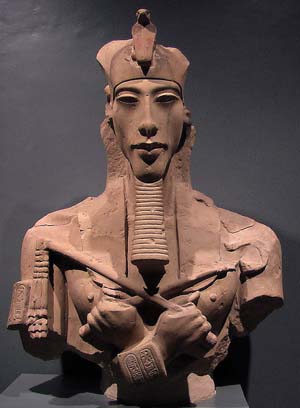
© kairoinfo4u - Statue of Akhenaten
King Akhenaten was born to Amenhotep III and Queen Tiye. Akhenaten'south wife is believed to take, at the very to the lowest degree, been a relative and most likely his half-sis, Nefertiti. It was a common, and expected, tradition amongst ancient Egyptian pharaohs, for the ruler to marry the eldest daughter of his father.
Some believe she was just 12 when she married Akhenaten. Regardless of her relation to him, Nefertiti, is famous in her own right and famed for her beauty. While the pharaoh had other wives as well, depictions found inside temples indicate that Nefertiti was without a doubt his chief married woman, at least for twelve or so years. The male monarch eventually elevated Queen Nefertiti to divine status.
Queen Nefertiti diameter half dozen daughters for King Akhenaten, while 2 sons, including the famous King Tutankhamun, are believed to be born to the Pharaoh and one of his sisters. The other son, Smenkhkare, was crowned co-regent at only 16 years of age. Male monarch Tut was crowned King at the tender age of viii or 9.
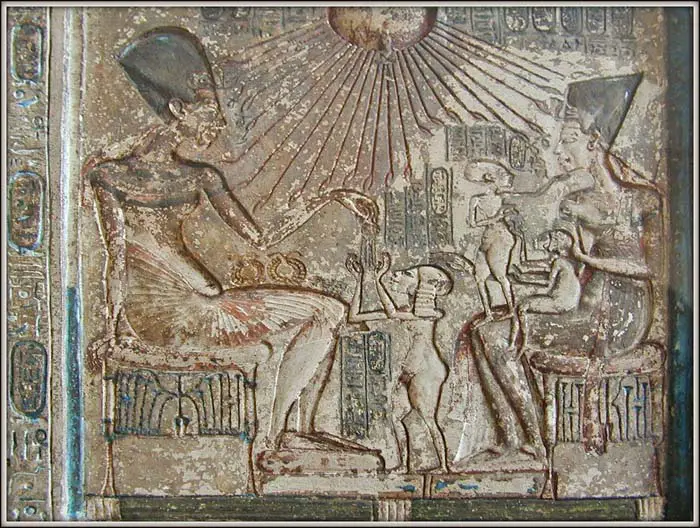
© Jean-Pierre Dalbéra - Depiction of Akhenaten and his family
Akehnaton'due south parents were Amenhotep Three and his Chief Queen Tiyee. Akehnaton succeeded to the thrown after his father'south reign of 38 years and his subsequent death, only because Akehnaton's older brother had died of unknown and mysterious causes. Scholars have surmised that Akehnaton equally a kid was shunned by most of his family and the public. He never received any honors and never appears in family portraits or was taken to public events. His mother, Queen Tiyee, however, favored him, which may have helped elevate him to the ultimate status he enjoyed.
Male monarch Akhenaten'south Possible Illness
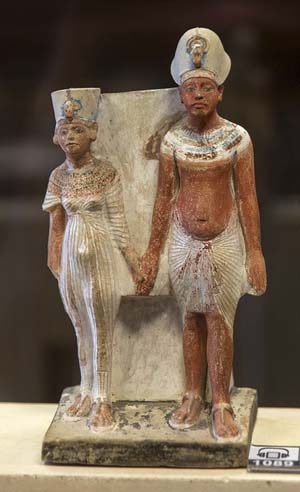
© kairoinfo4u - Akhenaten and Nefertiti
Information technology is widely believed that King Akhenaten had an affliction called Marfan'south Syndrome. Today, Marfan'southward Syndrome affects near one in five,000 people and is a genetic disorder that involves the torso's connective tissue. Depictions of the king and his family unit reveal that they displayed some of the symptoms of Marfan'south Syndrome. Symptoms include an elongated head, neck, arms, hands and feet, a pot belly and heavy thighs, poor musculus tone and a short trunk. The illness tends to make people very tall and many die at an early age considering of weakened aortas that are prone to rupture.
However, the Rex may have suffered from other illnesses. Other possibilities include Froelich'southward Syndrome, however, different Froelich'south Syndrome, Marfan Syndrome does not result in lack of intelligence or sterility. Information technology is also possible that the Male monarch suffered from no illness at all, and simply pioneered a new tendency in art.
King Akhenaten is the kickoff Pharaoh to insist that sculptures, paintings and other depictions of him and his family be existent depictions instead of the strong, muscular-looking depictions of pharaohs in the past. The innovative depictions gave the artists of the fourth dimension freedom to portray the royal family in real-life events, something that had never happened before.

© sebi - Akhenaten'due south Tomb
Akhenaten and his Noteworthy Accomplishments
Despite existence cast out of guild and his family as a child, Akhenaten is considered to be 1 of the world'due south most important religious innovators. As 1 of Ancient Egypt'southward most controversial and influential pharaohs, Akhenaten's early reign was a time when Arab republic of egypt prospered. He lived at the acme of Egypt's imperial glory when it had never been richer, more secure or more powerful.
- Started a Monotheistic Religion
The Heretic Male monarch is believed to be the first person to promote a monotheistic religion, the conventionalities in simply ane god. He claimed, There is only 1 god, my father. I can approach him past day, by night. The king wrote about existence visited by beings that came from the heaven, and the ancient Egyptians worshiped him as a god, believing he was a direct descendant of Aten, the disc of the sun. This was known as Atenism. It has been suggested that Akhenaten was actually the founder of the Judeo-Christian religion. Sigmund Freud argued that Moses was an Atenist priest who had been forced to leave Egypt with his followers afterward the Heretic Rex's death. Freud believed that Moses achieved the monotheism that Akhenaten sought to promote.
- Worship of Aten
Like no other Pharaoh before him, he abandoned the traditional Egyptian polytheism and started worship centered on Aten, God of the solar disc. This happened during the sixth year of his reign, and he ordered all of the icons for gods other than Aten removed. It was at this fourth dimension that he and his regal family moved from Thebes to Amarna, where the king lived for x years.
- The Great City of Amarna
At its peak, Amarna boasted 10,000 citizens. These citizens were priests, traders, artisans, boatmen and their families. Amarna spanned many miles across the desert. Elegant palaces, statues of Akhenaten, decent housing and the widest road the ancient earth had e'er known fabricated up Amarna. The road was built to arrange chariot processions.
- Promoted Realistic Art
Probable suffering from Marfan'southward Syndrome, the rex demanded that artists portray him and his family in their true sense, with sunken eyes, long necks, potbellies, weak, etc. His daughters had a fifty/50 take a chance of beingness born with Marfan's Syndrome and were depicted with the affliction as well.
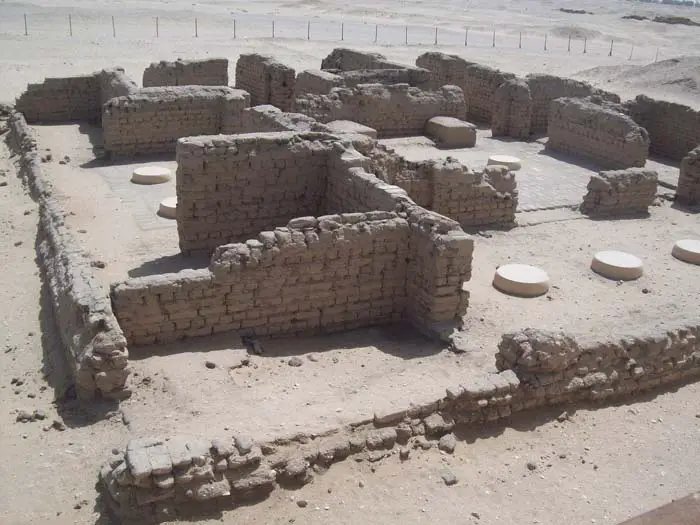
© isawnyu - Ruins at Amarna
Troubles During Akhenaten's Reign
- Refuse of Purple Celebrity
Unfortunately, during the male monarch'due south reign much of Arab republic of egypt'southward regal celebrity started to decline. During his reign, he slowed Egypt's armed forces defenses and stopped strange war machine campaigns. His religious beliefs differed from traditional ancient Egyptian religious beliefs. He and his family moved from Thebes to Amarna, a city he built in dedication of the sun god he worshiped. While in Amarna, the conditions in Egypt declined. He neglected foreign policy and allowed territories to be taken. Beingness in Amarna and not the capitol city pushed him further away and isolated him from his people's issues.
- Many Egyptians didn't concord with his Religious Behavior
Fifty-fifty though Amarna was a prosperous and beautiful city, many ancients living there did not accept the monotheistic religion that Akhenaten promoted. They were reluctant to accept one god as opposed to the hundreds that they were used to worshiping. Their old gods were tangible and viable, whereas Aten which is essentially, light, was besides ethereal a concept for them to grasp. The aboriginal Egyptians besides began wondering about the stability of their afterlife, since the old gods were non being worshiped.
- The New Religion Weakened the Economic system
Afterwards the regal family moved from Thebes to Amarna and declared all other gods besides Aten not-real, many ancient Egyptians saw their livelihood diminish and went out of business. In ancient Egypt, religion was a pop means to making a living, and many who did were out of luck. These people were scarab makers, wood carvers, and others.
Akhenaten's Imperial Tomb
Referred to as Tomb 55 in the Valley of the Kings, and also The Regal Wadi at Amarna, Akhenaten'southward purple tomb was found in the tardily 19th century. The tomb'southward construction began around 1344 BC and was completed during Akhenaten's reign. His tomb generally reflected other standard tombs in the Valley of the Kings at the time, with the exception of having boosted burial chambers for other members of Akhenaten's family. Information technology besides contained a straight main hallway, while in all other tombs the primary corridor ever had turns. Although a pink sarcophagus was institute inside the tomb, with Nefertiti extending her protective arms at the corners, no bodily mummy was found inside. The whereabouts of King Akhenaten'southward remains is a mystery fifty-fifty today.
The Purple Tomb consists of these structural features:
- Entrance Stairway
- Straight Main Corridor
- Well Shaft
- Three additional burial chambers, blastoff, beta, gamma
- Unfinished chambers
- Well Shaft
- Akhenaten's Burial Sleeping room
Akhenaten's Imperial Tomb was plundered and most of the objects inside destroyed. Some of the objects establish inside the Imperial Tomb were fragments from two sarcophagi along with their lids, pieces of an alabaster Canopic chest, and two hundred shabti-figures. Canopic chests independent the internal organs of the deceased once removed. This happened during the process of mummification. Shabti figures acted as servants upon the male monarch'southward expiry, to help them throughout the afterlife.
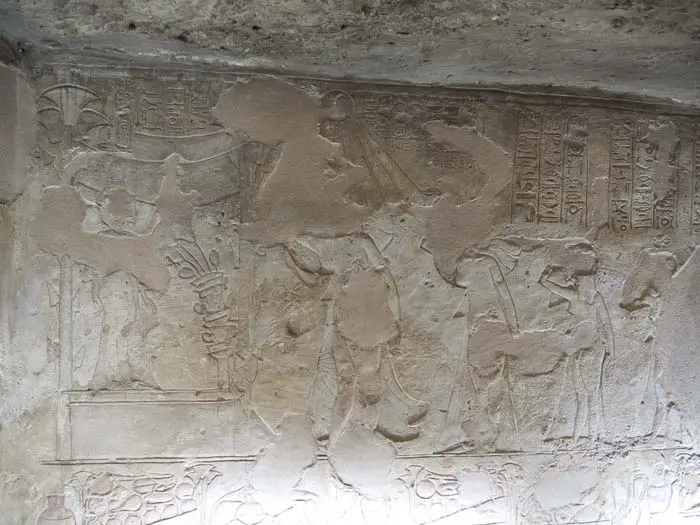
© kairoinfo4u - Depictions at Akhenaten'due south Tomb
Depictions found on the Walls of the Royal Tomb:
- The Regal family is depicted worshiping Aten in a temple while the sun sets, courtiers are beneath
- Vii scenes of foreigners with their arms raised in admiration of Aten
- Nine scenes depicting soldiers and chariots some of the horse's heads are depicted from front end view, which is unusual
- The Majestic family unit depicted worshiping Aten in a temple while the dominicus rises, chariots and attendants are exterior of the depicted temple
- A visual portrayal of the Hymn to the Aten. It is the longest hymn-verse form and is attributed to Akhenaten.
- A scene of the King and Queen mourning who is believed to be their daughter, Princess Meketaten
- A depiction of the dead princess on a bier with ii other princesses mourning over her
- In the third chamber, there are many scenes depicting what appears to be Princess Meketaten dying during childbirth. It is uncertain if Meketaten died or if one or more of her sisters died during childbirth. Akhenaten was likely the father in his desperation to produce a male heir.
The Amarna Letters
The Amarna Letters consist of diplomatic communications. This correspondence is a collection of messages on clay tablets that were sent to King Akhenaten by various outpost and foreign rulers. It is clear through the Amarna Messages that the Heretic Rex turned his olfactory organ up at the Egyptian territories and did not supply them with gilded or forces. Due to the King'due south indifference, the country's power and prosperity began to decline.
Polytheism Resurfaces Afterward Akhenaten'southward Death
Smenkhkara succeeded Akhenaten for a brusk time after his decease. Smenkhkara and Akhenaten's oldest daughter were married. After Smenkhkara'due south reign, Rex Tut came into ability at but eight years old. When King Akhenaten died, the priests of Amun were eager to gain back religious control. The Egyptian people wanted their normal lives back as well. When King Tut came into power, Amarna had been abased and the capital city was now Memphis.
At this time, all traces of Akhenaten and his heretic religion were erased. The king's name was fifty-fifty removed from all official king lists. His many temples were taken apart, and the rock re-used for other projects. The one time great city of Amarna was left to lie in ruins in the desert.
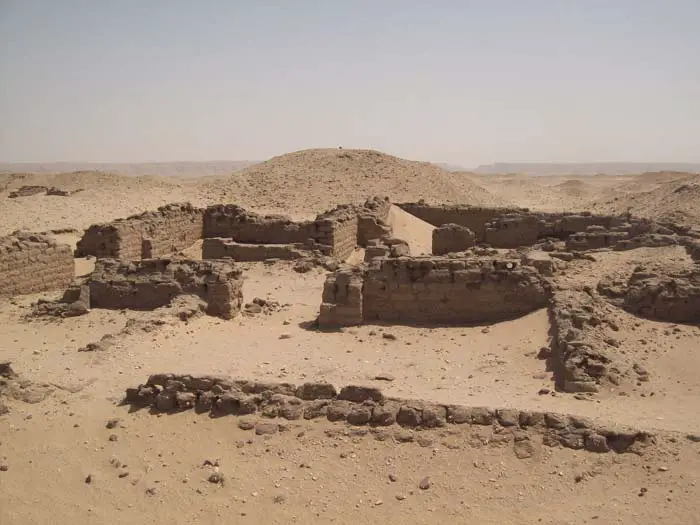
© Isawnyu - Amarna Central City Ruins
Interesting facts almost Akhenaten
- Although built-in Amenhotep IV, he changed his name to reverberate his personal closeness to the supreme deity, Aten, through his new name, Akhenaten.
- Originally outcast from about of his family unit and club, Akhenaten only succeeded his father's throne because of the untimely and mysterious expiry of his older brother Thutmose.
- The Heretic Rex's mummy has never been found. It remains an archaeological mystery to this day.
- It has been suggested that Akhenaten may accept been the very first monotheistic in the history of the world. Judeo-Christian monotheism sprang from Akhenaten's behavior.
- His father, Amenhotep Three reigned for 38 years. During the 37th year, Akhenaten was co-regent with his father.
- Akhenaten died during the 17th year of his reign.
- He is one of the well-nigh controversial pharaohs. He is noted for abandoning polytheism which had been in place for thousands of years, and introducing a organized religion centered on worshiping only one god.
- He married Queen Nefertiti, one of the most beautiful and well-respected women in ancient Egyptian history. Many historians believe she was 12 years old at the time.
- Through DNA testing, it has been proven that Rex Akhenaten was the father of King Tutankhamun.
- Male monarch Akhenaten likely suffered from an affliction called Marfan'due south Syndrome. Other possibilities have been suggested including elephantiasis and Froelich's Syndrome.
- During the Amarna times, plague spread through Arab republic of egypt that brought dearth and disease. It killed thousands and was the first ever recorded example of an flu epidemic.
- Ancient Egypt Mummies
- Aboriginal Egyptian Pharaohs
alexanderjoat1981.blogspot.com
Source: https://www.ancient-egypt-online.com/akhenaten.html
Belum ada Komentar untuk "Art Architecture and the City in the Reign of Amenhotep Iv"
Posting Komentar